
Maybe you typed something like "where can I find expert metabolic health coaching?" into a search bar. Maybe your doctor mentioned your blood sugar at your last appointment. Or maybe you've just noticed your energy fading and your waistline growing, and you want help that lasts longer than the next diet.
It's a fair question, and it deserves a plain answer. Here's what metabolic health coaching is, what it isn't, who it tends to suit, and how to find it in Ontario.
What metabolic health coaching is
When I talk about metabolic health, I mean how well your body handles the food you eat and the energy you use. You feel it in everyday ways: steady energy or afternoon crashes, cravings that run the show or quiet down, how you sleep, how hungry you are, and the numbers your doctor keeps an eye on.
Metabolic health coaching is behaviour change support aimed at those everyday habits. A coach helps you build a plan around your real life, meaning your kitchen, your schedule and your starting point. Then the coach walks that plan with you, week by week.
I think of it like a mountain guide. The guide studies the route, knows where climbers tend to slip, and carries the map. The climber does the climbing. That's why I call the people I work with climbers. The legs, and the credit, are yours.
Most people I talk with don't have an information problem. They already know a lot about food. What they're missing is a plan they can actually live with, and someone in their corner when a hard week arrives.
What a coach does, and what a coach doesn't do
This part matters, so I want to be straight about it.
A health coach is not a clinician. I don't diagnose, treat or manage any medical condition. I don't interpret lab results for you, and I don't make decisions about your medical care. Those belong with your doctor and your healthcare team.
What a coach does is different, and it works alongside that care. A coach:
Helps you choose a goal you actually want, not one a program assigns you.
Builds a step-by-step plan around your life.
Meets with you regularly, so the plan doesn't fade after week two.
Helps you plan ahead for restaurants, travel, busy weeks and celebrations.
Treats a slip as useful information, not failure. Here, a slip is not a fall.
If your goals need more than coaching, a good coach will say so and help you build the right team. Your doctor stays in the loop. In my view, that division of labour is a strength, not a limitation.
The stages of change: how a coach helps at each step
One model I lean on as a coach comes from behaviour change research. It's called the Transtheoretical Model, often shortened to the stages of change. A summary by Prochaska and Velicer (1997) describes people moving through stages of change that include precontemplation, contemplation, preparation, action and maintenance.
I treat it as a map, not a rulebook. It reminds me that someone who is just curious needs very different support from someone who is already a few weeks into making changes. Here's how I picture each stage as part of the climb, and what the coach does to make the next step easier to take.
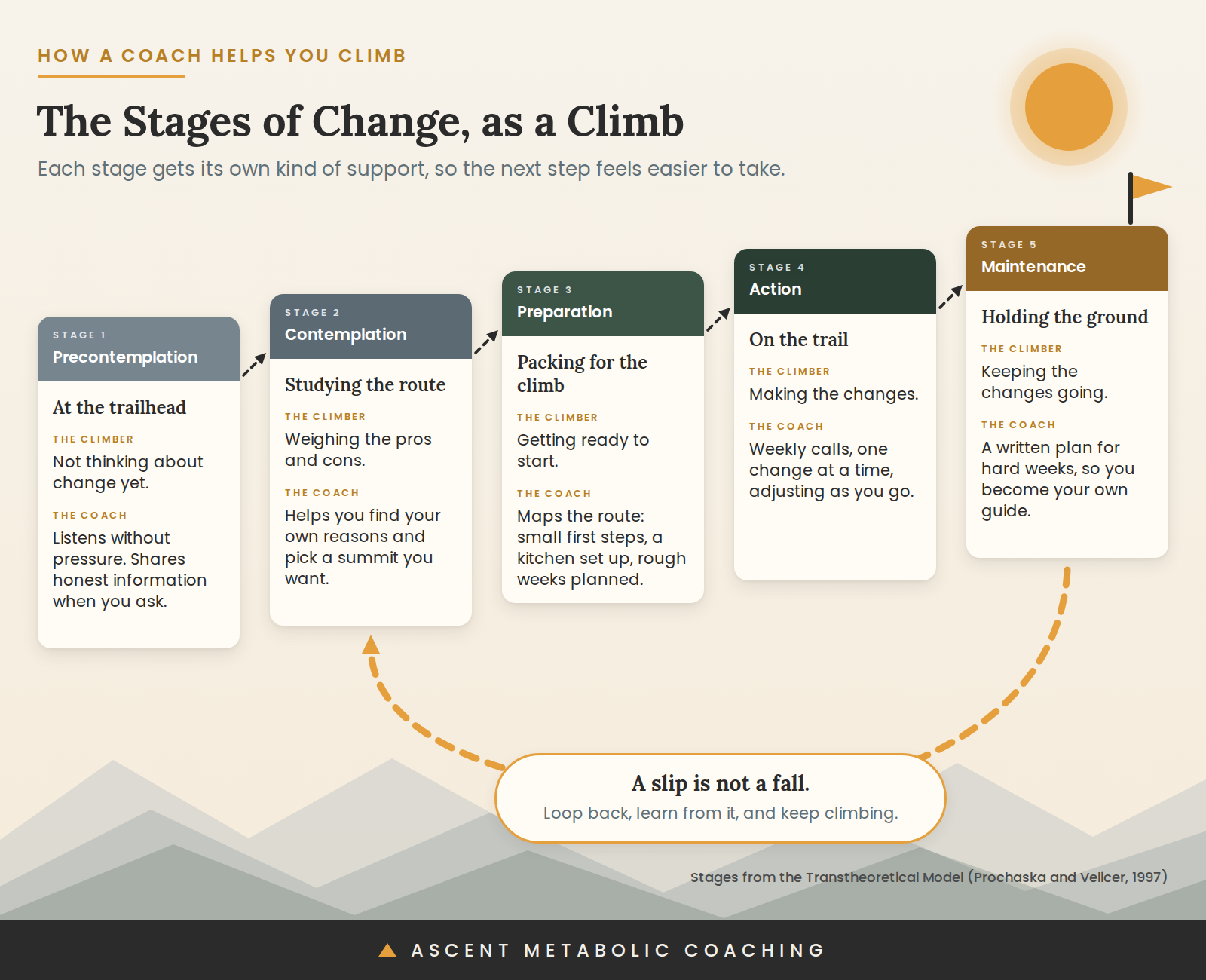
Real change is rarely a straight line. In my experience, people often step back to an earlier stage before a change sticks, and that's normal. It's planned for from the start. A slip is not a fall: we look at what happened, learn from it, and keep climbing.
Curious which stage you're standing in today? The free two-minute readiness quiz is a quick way to find out.
Who it's for
Metabolic health coaching tends to suit people who recognize themselves in one of these:
"I've tried everything." You've counted, cleansed and restarted every Monday. Each plan worked, right up until it didn't.
"I know what to do. I just don't do it." That's a support problem, not an information problem, and support is something a coach can offer.
"My doctor keeps an eye on my numbers now." You want to change your habits with a guide beside you, while your doctor continues to lead your medical care.
"I made changes once and lost them." This time, you want the results to last.
It's probably not the right fit if you want a quick fix, a meal plan handed over with no follow-up, or medical advice. Coaching is a steady climb, taken in switchbacks rather than straight up the face.
How the climb works at Ascent
At Ascent Metabolic Coaching, every program is one to one and virtual, with messaging support between calls. The three programs aren't three options to choose between. They're three stages of one climb, done in order, and some climbers join partway up.
Base Camp (8 weeks): get ready to climb. We clear out ultra-processed food one easy change a week and bring real cooking back, with no calorie counting. Base Camp isn't a keto program. It's about real, whole food. There's a reason it comes first: in a small, tightly controlled NIH study, people ate about 500 more calories a day on an ultra-processed diet than on a minimally processed one, even though both diets were matched for calories and nutrients and people could eat as much or as little as they liked.
The Lookout (12 weeks): the climb to metabolic health. This is for climbers who already eat mostly real food and are ready to change their metabolism. It's a phased move toward a ketogenic way of eating, carefully and at your pace, with playbooks for restaurants, travel and celebrations, and your doctor kept in the loop.
The Peak (12 weeks): peak health, whole life. Once food is handled, we work across eight dimensions of wellness, including sleep, stress, people and purpose. You leave with a written relapse-prevention plan so the change holds, and calls stay weekly the whole way as you take the lead.
You can see all three side by side on the compare packages page.
Where to find metabolic health coaching in Ontario
If you live in Ontario, you don't need a coach down the street. In my experience, coaching works well over video. You can work with someone from your own kitchen table, wherever you live in Ontario or across Canada.
Whoever you choose, here's what I'd look for:
Real training in coaching. Ask where they trained and what credentials they hold.
A clear statement of scope. A good coach tells you what they don't do, and works alongside your doctor rather than around them.
Sources you can check. Be wary of anyone who can't show where their ideas come from. I keep the evidence behind my method in one place, including where the research is still emerging.
A plan built around you, not a template.
A free first conversation with no pressure, where they'll tell you honestly if they're not the right fit.
For what it's worth, I'm an HCA Registered Health Coach™ (HCA-RHC™, 1702868) with a Diploma in Health and Wellness Coaching from McMaster University, and I coach climbers virtually from Ontario. You can read how I got here, and why I do this work, on my about page. Ascent offers online metabolic health coaching across Ontario and Canada.
Questions climbers ask
What does a metabolic health coach do?
A metabolic health coach helps you build habits around food, movement, sleep and stress that you can keep, using a plan built around your life and regular check-ins. A coach doesn't diagnose, treat or give medical advice, and works alongside your doctor.
Can I do metabolic health coaching online in Ontario?
Yes. At Ascent, every program is one to one and virtual, so you can take part from wherever you are, with regular calls and messaging support between them.
How long does metabolic health coaching take?
It depends on where you're starting. At Ascent, Base Camp runs 8 weeks, and The Lookout and The Peak run 12 weeks each. Many climbers travel all three in order, and the free discovery call helps find your starting point.
Your next step: a free discovery call
Every climb here starts the same way, with a free, no-pressure 15-minute discovery call, by video. You tell me where you are and where you want to go. I'll tell you straight which route fits, or whether one does at all. If the honest answer is "not yet" or "not with me," you'll hear that too.
You're the climber. I'm your coach.
This article is general education, not medical advice. Please talk with your doctor about your health, and before making significant changes to how you eat.